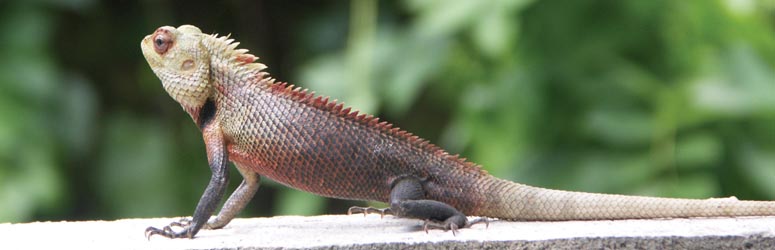
Calotes versicolor, Length of head once and a half to nearly twice its breadth; snout a little longer than the orbit; rostral relatively very small, less than one fifth of mental; mental large, sharply pointed behind; nasal scale more than twice size of nostril, separated from the rostral by two scales forehead concave; cheeks muscular and swollen in the adult male; upper head scales unequal, smooth or feebly keeled; two well-separated spines on each side of the back of the head above the ear; canthus rostralis and supraciliary edge sharp; diameter of tympanum half or less than half of the orbit. Body compressed; dorsal scales, smooth, irregular, rather larger than ventral scales, more or less distinctly keeled and sometimes mucronate in the adult male, all pointing backwards and upwards, larger than the ventral scales, which are always strongly keeled and mucronate; 35 to 52 scales round the middle of the body. No gular pouch, except in the male during the breeding season, when a small one develops; gular scales as large as or larger than the ventrals, strongly keeled and mucronate in the adult male. No fold or groove on front of the shoulder. Nuchal and dorsal crests continuous, well developed in the male, composed of lanciform or falciform spines gradually decreasing in size towards the posterior part of the back. Limbs moderate; third and fourth fingers nearly equal; fourth toe longer than third; the hind limb reaches to the temple or the eye. Tail long, cylindrical and swollen at the base in the male, rounded or feebly compressed, covered with sub equal, keeled scales. SUP: 9-12, INF: 9-12, MBS: 42; SVL: 128 mm; HL: 40 mm; AG: 56 mm (Daniel, 2002; Smith, 1935; Taylor, 1953; Deraniyagala, 1953).
The body color is changeable from grayish brown to yellow ochre or dull pink, A dull pink gular area is bluish black at base of throat, more or less distinct dark brown transverse spots or bars on the back and sides; or variegated with dark brown; dark streaks radiating from the eye; young and females often with two light yellow dorso-lateral stripes; tail with light and dark annuli. Dirty whitish below, often streaked with dark brown or black. Fully-grown males are usually more or less uniform in color and have sometimes a greenish tinge; the throat may have a black transverse bar. The local population differs very greatly in coloration. New born and young are feebly iridescent golden yellow with patterns. Females are considerably smaller. Animals from the Indian peninsula are considerably larger than those from Indo-Chinese region (Annandale, 1906; Daniel, 2002; Deraniyagala, 1953; Smith, 1935 Taylor, 1953).
Calotes versicolor is the most common, most abundant and widespread agamid in Sri Lanka and found throughout the island except in elevations of more than 1,400 m (Erdelen, 1984; Manamendra-Arachchi & Liyanage, 1994). The known distribution of this species is from South-eastern Iran to Afghanistan and Nepal, India to Sri Lanka, Myanmar to Indo China, Southern China to Peninsular Malaysia, Hong Kong, Andaman Islands and Sumatra and there is a considerable variation in this very wide spread species (Günther, 1864; Radder, 2006; Smith, 1935; Taylor, 1953; Zug et al., 2006) and according to recent distribution, now exotic in Florida, USA (Enge & Krysko, 2004).
Calotes versicolor is not found in all kinds of habitats. It has never been found within closed forests. It is most abundant close to human settlements where the vegetation is strongly influenced by man. The species are largely arboreal and occurs mainly in scrub jungle throughout Sri Lanka (Erdelen, 1978; Manamendra-Arachchi & Liyanage, 1994). Each male maintains a territory and displays from an elevated site within it (Daniel, 2002).
This species feeds on young leaves, seeds and buds as well as nestlings, frogs, insects, such as hemipterans and hymenopterans, their larvae, spiders and worms (Daniel, 2002) and sometimes feed on Geckos and snakes (Shanbhag, 1991, 1999). Some times they are cannibalistic (Daniel, 2002).
C.versicolor produces multi-clutches and mating occurs in April to October (Shanbhag et al., 2000b). The female invests different quantities of yolk in her eggs depending upon the breeding time (Radder et al., 2004). The female digs a nest hole in the ground about 45.5 - 60 mm and deposits 6-14 eggs in June- January. The eggs are 13.3-18 mm x 7-11.5 mm. The Period of incubation is 42-76 days (Amarasinghe & Karunarathna, 2007, Das & De Siva, 2005; Deraniyagala, 1953; Smith, 1935).
Conservation status: Large, widely dispersed and stable population (Manamendra-Arachchi & Liyanage, 1994). Least Concern (Bahir & Surasinghe, 2005)
|